

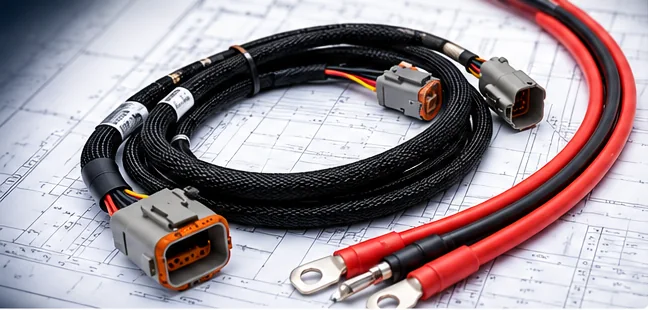
The fastest way to get an accurate wire harness quote is to send a complete request for quote (RFQ) package. Missing information leads to assumptions, and assumptions lead to re-quotes, delays, and surprises at First Article. Here is what a complete package looks like.
1. The drawing or print
Your drawing is the core of the package. It should show:
- Overall layout with breakout locations and branch lengths
- Dimensions and tolerances, and where they are measured from
- Connector views with cavity numbering
- Protective coverings such as sleeving, convoluted loom, tubing, or heat shrink, and where each starts and stops
- Labels and wire markers, including content and location
- Notes for workmanship class (for example, IPC/WHMA-A-620 Class 2) and any special requirements
PDF works for review. If you have native CAD or DXF files, include them as well.
2. The bill of materials (BOM)
List every component with manufacturer and manufacturer part number: connector housings, terminals, seals, wedges or locks, backshells, wire, sleeving, heat shrink, and labels. If you accept alternates, say so and list approved equivalents. Approved alternates can shorten lead times and reduce cost.
3. The wiring table or pin-out
A from-to table that lists each circuit, its wire gauge, wire type (for example, TXL or GXL automotive wire, or UL1007 hookup wire), color, and the connector and cavity at each end. This is what the test fixture is built from, so accuracy here matters.
4. Electrical test requirements
State which tests each harness must pass, such as continuity, pin-out, short/open, and hipot, along with any test voltage or resistance limits.
5. Quantities and timeline
- Prototype or First Article quantity
- Estimated annual usage (EAU) and typical release quantities
- Target dates for prototypes and production
- Project stage: new design, transfer from a current supplier, or ongoing production
Volume has a big effect on tooling, fixtures, and unit price, so even a rough EAU helps.
6. Packaging, labeling, and compliance
Note any packaging, part labeling, or documentation requirements, such as Certificates of Conformance, country-of-origin requirements, or RoHS and REACH declarations.
What happens after you send it
Our U.S.-managed engineering team reviews your package for manufacturability, flags any open questions, and prepares a quote. Before mass production, First Article Inspection delivers physical samples with full dimensional and test reports for your engineering approval. All drawings, BOMs, and CAD files are protected under a strict mutual NDA and remain your company’s intellectual property.
Ready to start? Submit your drawings and BOM for a fast, detailed quote, or review our capabilities first.